Top 10 ANSI Aerial Lift Standards Every Buyer Should Know
An aerial lift may look ready for work, yet a buyer cannot judge safety from clean paint or a smooth control panel. Ansi Aerial Lift Standards provide a practical framework for evaluating equipment design, operation, inspection, and training. The relevant ANSI/SAIA A92 standard depends on the lift type and its intended use, so a scissor lift and a boom lift should not be treated as interchangeable. Details matter.
Before comparing models, buyers should consider the worksite: uneven ground, overhead obstructions, narrow access routes, and the height workers must reach. Rated capacity matters too. A worker, tools, and materials all count toward the platform’s load. Ask suppliers for the applicable standard, operator and maintenance documentation, inspection guidance, and clear information about the machine’s limits. Check that the instructions match the exact model being considered.
The ten standards highlighted in this guide can help buyers ask more informed questions about platform design, stability, controls, fall protection, and safe use. They are a starting point, not a substitute for manufacturer instructions or qualified advice. Requirements and editions can change, and the right interpretation may depend on the equipment and workplace. That uncertainty deserves attention. A checklist can prevent oversights, but it cannot inspect a lift or correct a rushed decision. Verify current documentation before purchase, and make sure the people who will operate and maintain the equipment understand it.
Understanding the ANSI A92 Standards for Aerial Lifts
Top 10 ANSI Aerial Lift Standards Every Buyer Should Know
Understanding the ANSI A92 Standards for Aerial Lifts
ANSI/SAIA A92 is not one checklist; it is a family of standards for mobile elevating work platforms (MEWPs). A92.20 addresses design, calculations, safety requirements, and testing. A92.22 covers safe use, including site assessment, inspections, operation, and emergency planning. A92.24 sets training requirements for operators and supervisors. Buyers should confirm which edition applies, then match platform height, capacity, outreach, and terrain limits to actual tasks. Labels matter. So do manuals.
The practical stakes are clear. OSHA’s aerial-lift guidance cites historical U.S. estimates of 26 construction worker deaths and 1,300 injuries annually in lift accidents during 1992–1999. This older figure is not a current risk rate, but it shows why standards and worksite controls matter. Before purchase, check documented conformity, guardrails, emergency-lowering controls, load charts, inspection procedures, and training materials. A compliant design cannot correct poor ground conditions or an overlooked overhead line. That distinction is easy to miss.
Tips: Ask the supplier to demonstrate emergency lowering and explain the machine’s slope and wind limits. Compare specifications with your narrowest aisle and roughest surface. Keep the answers in writing; memory gets fuzzy after delivery.
Identifying Aerial Lift Types and Their Applicable Standards
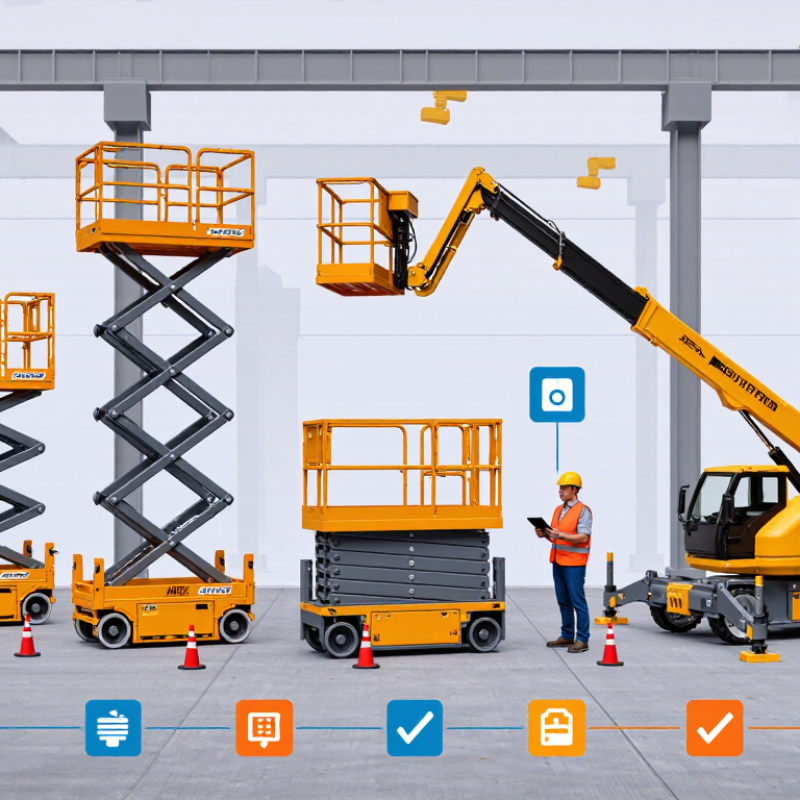
A buyer should identify the machine before comparing its ANSI requirements. Scissor lifts generally fall into Group A: their platforms stay within the tipping lines. Boom-supported lifts are typically Group B because the platform can extend beyond those lines. ANSI/SAIA A92.20 covers design, calculations, safety requirements, and testing for mobile elevating work platforms (MEWPs). Vehicle-mounted elevating and rotating devices have a separate standard, ANSI/SAIA A92.2. The distinction matters.
Classification also includes how a lift travels while elevated. Under A92.20, Types 1, 2, and 3 describe where controls operate and whether movement is permitted with the platform raised. A92.22 addresses safe use; A92.24 covers operator training. Together, these standards help buyers assess more than platform height. Check the machine’s data plate and manual. On a busy site, that small label can be easy to overlook.
IPAF’s 2024 Global Safety Report recorded 1,080 reported incidents and 85 fatalities across 34 countries in 2023. These figures are reported events, not a complete count of every incident, but they underline why correct selection and training matter. For a narrow indoor aisle, compare a compact vertical lift’s dimensions and floor loading. For work over obstacles, assess a boom lift’s reach and ground conditions. Match the machine’s type, use environment, and applicable standards before purchase.
Reviewing Design, Stability, and Fall Protection Requirements
ANSI A92.20 addresses aerial-lift design, including structural strength, stability, and platform safeguards. Buyers should compare rated capacity with the real task: workers, tools, and materials all count. Check whether the platform’s load limit changes with extension, and review slope and wind limits. Small details matter. A sensor may stop unsafe movement, but it cannot correct poor setup on soft or uneven ground. I would also ask for stability-test documentation and clear emergency-lowering instructions, not just a product sheet.
Fall protection and safe operation connect design to daily work. ANSI A92.22 covers safe-use practices, while A92.24 addresses training. OSHA’s aerial-lift guidance reports 26 construction-worker deaths in scissor-lift incidents from 1992 through 1999; falls, tip-overs, and electrocutions were identified hazards. That historical figure is not a current risk rate, but it shows why guardrails, entry gates, and platform controls deserve close inspection. For boom-supported lifts, verify the manufacturer’s instructions for harness use and approved anchorage points. Never assume a guardrail alone answers every fall-protection question. Ask how operators will handle alarms, ground conditions, and emergency descent. Some buying checklists still overlook these practical details. A careful review can catch gaps before the lift reaches the jobsite.
Verifying Compliance Documents Before Purchasing an Aerial Lift
Before buying an aerial lift, identify which ANSI/SAIA A92 standards apply to its type and manufacture date. A92.20 covers design and safety requirements for mobile elevating work platforms. A92.22 addresses safe use, while A92.24 covers training. Applicability matters. A document for a different lift category may not verify the machine you are considering.
Request the operator’s manual, maintenance history, inspection records, and available compliance documents. Match the model and serial number on each document to the machine’s data plate. Check that platform capacity, configuration, and installed options also agree. Look for revision dates and clear references to the applicable standard. Missing records matter. A recent inspection report is useful, but it does not replace required operating instructions or prove every past repair was completed correctly.
Be cautious of a seller’s broad “ANSI compliant” statement. ANSI does not issue one universal certificate for every aerial lift; ask what the claim specifically refers to and who prepared the supporting documentation. If records conflict, request clarification before payment. Paperwork is rarely perfect, but unexplained gaps should not be waved away. Compare the documents with the actual lift, including labels, controls, and visible modifications. A careful review takes time. It is still cheaper than discovering a mismatch after delivery.